Coaching

Book Review: Harmony From the Inside Out

harmonybookI picked up this book while I was out in Philadelphia for the Barbershop Harmony Society’s International Convention, having heard several people talk about it. Its author, Jan Carley, sings with the Lions Gate Chorus in Vancouver and also works as a professional life coach, and the purpose of the book is primarily to apply the principles of life-coaching to working with barbershop choruses. She has had some significant successes in helping Sweet Adelines choruses (most especially the Lions Gate Chorus) enjoy rapid increases in both performance level and morale, and this book outlines her approach.

Royce Ferguson in Action

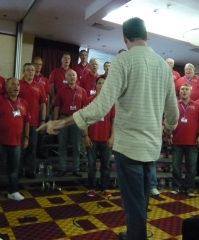
Royce Ferguson with the Cottontown ChorusRoyce Ferguson with the Cottontown ChorusAt the BABS convention last week I had the opportunity to observe Royce Ferguson coaching Bolton’s Cottontown Chorus. Royce is best known in the barbershop world as the director who took the Westminster Chorus to their first two international chorus medals in 2006 and 2007. It is not surprising therefore that he is in considerable demand as a coach and he is becoming a regular visitor to the UK in that capacity.

In his work with Cottontown he focused on the integrity of tone, on maintaining a sound that was neither breathy nor pushy. Indeed, he identified putting energy behind a breathy tone as the primary cause of vocal strain. He relentlessly insisted on a refinement of tone in which the voice is ‘always connected but never heavy-handed’. It is an active tone, not a passive one, which needs constant attention to keep it centred. He talked a lot about letting the natural beauty of the sound resonate without feeling the need to do things to it:

Back to Bristol

bristolfashion2Saturday saw me back down with my friends in Bristol Fashion for a day’s coaching. Like last year they had provided wonderful weather, and even better, this year they had space outside in which to enjoy it over lunch. Since I last visited they have picked up trophies for most improved chorus and most improved director at LABBS Convention, and are singing with an increased sense of panache for having had their efforts validated.

Amersham Again

Amersham A Cappella: warming up with Lynne OwenAmersham A Cappella: warming up with Lynne Owen
I was back in Amersham this week working with Amersham A Cappella in anticipation of their participation in the BBC Choir of the Year later this month. Their director Helen Lappert is brilliant at defining an agenda for the evening, and our goals were to:

  1. Fine-tune performances for Choir of the Year
  2. Increase the magic
  3. Enhance individuals’ performances
  4. Increase projection beyond the footlights

Carfield Community Choir

Carfield Community ChoirCarfield Community ChoirI had a fun evening on Monday with Carfield Community Choir in Sheffield. They started a few years back as a choir of parents of children at a local primary school, and have gradually taken on an independent identity – though they still rehearse at the school, they have gradually acquired members who are not associated with it. They are directed by Liz Nicholas, who stepped out to keep things going when their original director moved on. Liz, like me, started out as a pianist (in fact we both studied with the same teacher, though not at the same time), who gradually moved through accompaniment to leading singers as she discovered how much more fun you can have making music with other people than alone in a practice room.

The workshop for Carfield was a bespoke version of my sessions on Developing the Ensemble and Aural Skills for Choral Groups. These are clearly related themes, so it took its focus in the overlap areas, with an emphasis on the listening dimension of developing togetherness as a performing group and the mutual responsiveness dimension of aural skills.

Going for Green

gsb17apr10On Saturday I was back with my friends in Sevenoaks as the first half of a double-bill weekend of coaching for Green Street Blues. They were spending the Sunday with Mark Grindall working on vocal issues, and it was good to have him around during the day so we could coordinate our to-do lists. (He also took this photo – thanks Mark!) Since I saw the chorus last September, they have acquired about 25% more singers, bronze chorus medals from LABBS and the title of Top Choir of Kent, and also – not surprisingly - a certain sense of confidence.

How can I retain what I’ve learned?

Retention is the Achilles heel of a performance coach. It’s one thing to go and help an ensemble significantly improve their performance, but unless the coaching results in some kind of longer-lasting improvement, it has not done its job. It may of course have given the singers a good time, so was still a valid use of the session - but there is a difference between a fun workshop and coaching.

There are a number of elements or stages to the process of retention, and I suspect that the secret lies in combining them effectively.

The Tea-Towel Test

teatowelOne of the minor peculiarities of barbershop culture (as opposed to its various major peculiarities) is the way it uses the word ‘theme’. Generally, if you ask someone what a song’s theme is, they’ll either give a poetic or literary response – love, loss, nostalgia, that kind of thing – or point to the primary identifying melodic idea as you would to identify themes in a Beethoven symphony. But what barbershop judges (well, specifically Music and Presentation judges) mean when they say ‘theme’ is the primary musical element in that particular arrangement.

Now, this can be quite a useful question to ask. The term is odd, but the concept is serviceable. One of the main differences between a performance that sounds like people just obediently singing the notes and words and one that carries musical meaning is a clear sense of what the song’s main musical strength is. What a song is primarily ‘about’ does not always lie in the lyrics: if the thing that stays with you days later is the shape of the melody or the groove of the rhythm, then that should be your starting-point for interpretive decisions.

The thing about a song’s theme, then, is that it can stand alone. The main test for if a song has a lyric theme is if it makes sense to print the words on a tea-towel.

...found this helpful?

I provide this content free of charge, because I like to be helpful. If you have found it useful, you may wish to make a donation to the causes I support to say thank you.


Archive by date

Syndicate content Syndicate content