
BABS Convention 2026
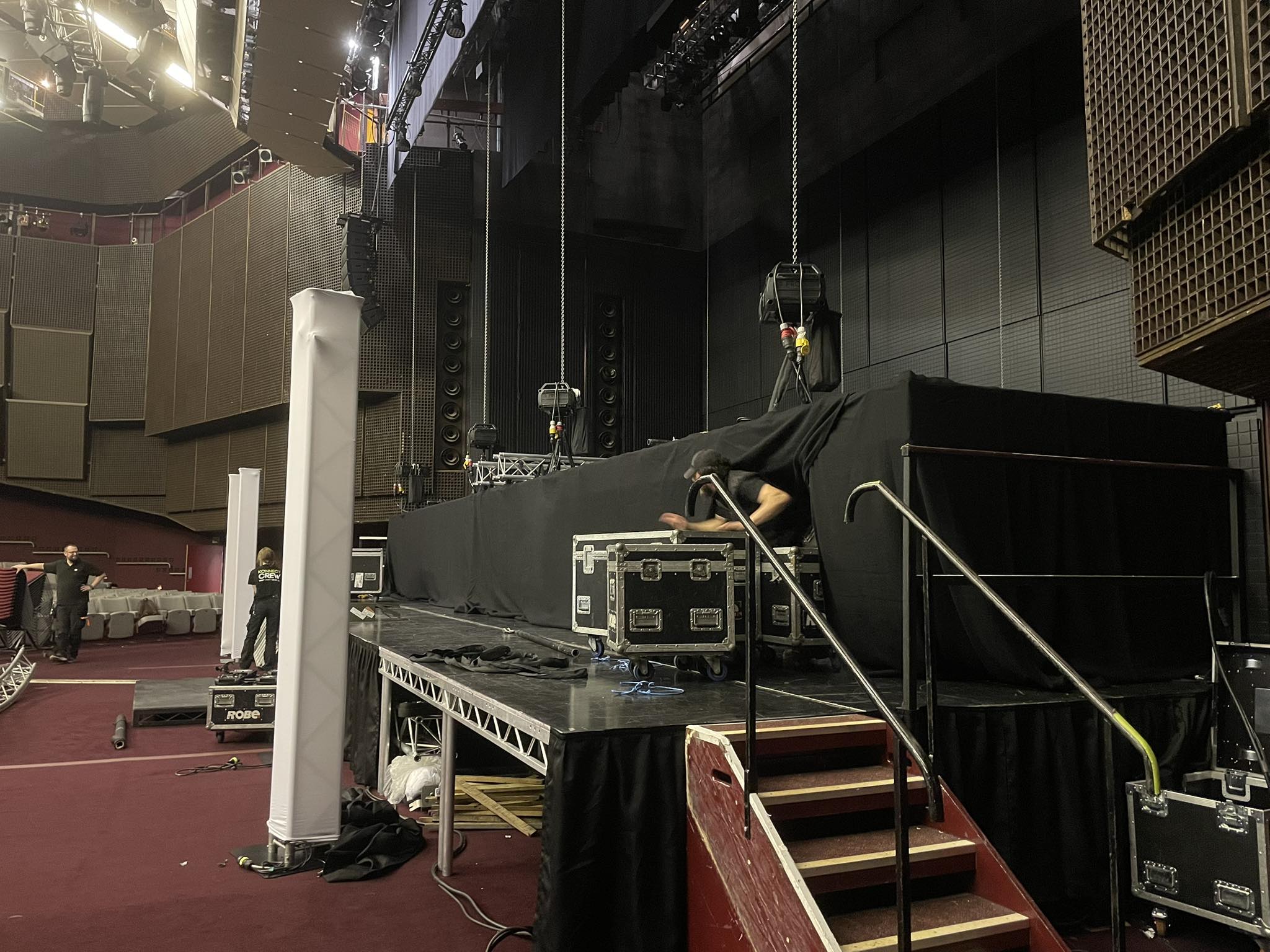 A snapshot of the pre-convention set-up: let's not forget the behind-the-scenes efforts that make all the performances possible
Summer arrived suddenly in the UK at the end of last week, just in time for the annual convention of the British Association of Barbershop Singers. I was only there for one day again this year, as Rainbow Voices were performing at Birmingham Pride on the Friday night, but as it turned out, the changes in the convention schedule this year meant that I could see all the quartet contests, not just the national finals on the Sunday. The same changes meant however that I saw none of the choruses, so everything I know about those contests is entirely second-hand. Fortunately, when you turn up in Harrogate on a convention weekend, it doesn’t take long before you meet someone in the street to report on what you missed.
I realised part way through the day that it was 30 years to the weekend since my first encounter with the organised barbershop scene. (I’d had the odd brush with the music before then but no direct experience of the culture that sustains it as a living tradition.) This inevitably led to reflections on continuity and change. It turned out that the lead of the national men’s champion quartet from 1996 was this weekend singing his swansong as lead of the outgoing senior’s champion quartet, and thus encapsulated both at the same time.
Musically, I was entertained to notice that some songs, such as 'Once Upon a Time' and 'Blue Skies', that we experienced this year as barbershop classics amongst the profusion of newer arrangements were, when I first encountered them in the late 1990s, under question as to whether they were really suitable for contest at all. I recall Jay Giallombardo talking about the Test of Time as the true arbiter for these questions, which at a philosophical level I find somewhat problematic, but at a pragmatic level seems to apply well to these cases.
Another change I was struck by was how much it is the norm these days to see quartets with members from multiple different choruses, often at some geographical distance. Quartets representing just one club are these days the exception rather than the rule. Even where a club clearly has a vibrant quartet culture (both Meantime and the Telfordaires had a striking number of their members competing in quartet this weekend), the quartets usually also had members from other groups.
It is interesting to consider what lies behind this change. I am sure that the whole Harmony Brigade/Extreme Quartet cultue is a major part of it, as it has provided people with so many more opportunities to connect with other people who are interested in quartetting, as well as the chance to try out different combinations of voices to test compatibility. It is essentially a musical speed-dating scene which fosters the formation of new relationships amongst those who want to go steady.
I wonder how much changes in technology have also facilitated it. Clearly, proper rehearsing together remotely is still not a viable option, try as we did during covid to make it work, but the ease and cheapness of staying in touch compared to 30 years ago allows a lot of ready communication to facilitate the operation of a long-distance quartet around the inevitable travelling. Simple things like recording your part and sending it to the others to duet with in practice is so easy now. It was I suppose in principle possible in the 1990s, but duplicating cassettes and putting them in the post is a whole load of faff that I don’t think people did very much.
There are also some interesting things to reflect on in terms of culture change within BABS, but I think they may need more mulling, and more space than would fit here so I’ll come back to them another day.
Probably the biggest change I noticed may have been in part an artefact of attending a day in which there were only quartet contests: how it felt like a significantly smaller convention overall. This was in some ways pleasant – the queues for refreshments were shorter, and the afterglow was less sweaty and noisy. I imagine the Saturday evening, with a full day of chorus contests plus an evening show was probably much more heavily populated.
Still, the convention this year was just two days, rather than the 3 ½ it used to be, which suggests the impression of a more intimate event may actually reflect something about numbers of participants overall. And if numbers of delegates were the only way to gauge the health of an organisation, you might worry about that.
But the other big performance indicator for a singing organisation is: how did the voices sound? And on the basis of that, I came away feeling optimistic. It’s not just that I heard a good deal of skilled music-making, it’s that there was overall a sense of freedom and balance in the voices that you hear when people are in their happy place. Integrity of sound has a deep and holistic relationship with emotional health, and both are a joy to hear.


You may also like ...
|
Node 2,688
Weight = 3. Common link to https://www.telfordaires.co.uk/ (2), One tag in common [477 posts have this] A Cappella (1) 
|
Node 2,724
Weight = 3. Common link to https://www.telfordaires.co.uk/ (2), One tag in common [477 posts have this] A Cappella (1) 
|
Node 2,583
Weight = 3. Common link to https://www.telfordaires.co.uk/ (2), One tag in common [477 posts have this] A Cappella (1) 
|
Node 2,619
Weight = 3. Common link to https://www.telfordaires.co.uk/ (2), One tag in common [477 posts have this] A Cappella (1) 
|
...found this helpful?
I provide this content free of charge, because I like to be helpful. If you have found it useful, you may wish to make a donation to the causes I support to say thank you.
Archive by date
- 2026 (18 posts)
- 2025 (24 posts)
- 2024 (46 posts)
- 2023 (51 posts)
- 2022 (51 posts)
- 2021 (58 posts)
- 2020 (80 posts)
- 2019 (63 posts)
- 2018 (76 posts)
- 2017 (84 posts)
- 2016 (85 posts)
- 2015 (88 posts)
- 2014 (92 posts)
- 2013 (97 posts)
- 2012 (127 posts)
- 2011 (120 posts)
- 2010 (117 posts)
- 2009 (154 posts)
- 2008 (10 posts)
