Coaching

Coaching Coast to Coast

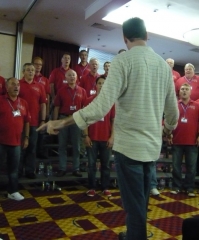
Coast to Coast in warm-up modeCoast to Coast in warm-up modeCoast to Coast, the national chorus of LABBS, invited me to coach them on Sunday as part of their retreat weekend. The chorus comprises singers from across the country, and meets once a month, usually on a Sunday. Many of its members sing with small choruses, and find that Coast to Coast offers them not only the chance to sing in a larger group, but provides a wider networking opportunity to exchange ideas and advice to take back to their home clubs.

The chorus had spent the Saturday on big-picture questions such as planning the group’s development and exploring their understanding of the music. Their new director, Linda Blackett, has identified as a medium-term goal to work on musicianship, and having the extra day together gave them the chance to do activities that focused on the skills of the singers and not just preparing for their next performance – a nice bit of work on production capacity, not just production.

Green Street Blues and the Integrated Song

GSB7sep10
On Tuesday I spent an evening with Green Street Blues to help kick off their pre-convention preparation season, and the focus of our work was on the new contest uptune that they commissioned from me earlier in the year. During my last visit back in April we had established the overall expressive approach to it, and our task now was move into the detail.

Bristol Fashion and the Quest for Freshness

bristolsep10On Sunday I made another coaching visit to my friends in Bristol Fashion chorus as they start their pre-convention season of contest preparation. They had had the foresight to record their contest package on their rehearsal night last week and send them to me in advance, and it was great to be able to spend some time on the way down formulating ideas for our day’s work from a really up-to-date snapshot of their work.

One of the issues the chorus is grappling with how to get the benefit of deep familiarity with a song whilst keeping their relationship with it fresh. This is a dilemma that all ensembles face in some way or another. You need new repertoire to expand your artistic horizons and stretch you emotionally and technically; but you also need to be able to get beyond the practical issues of getting the notes and words right to be able to develop depth and insight. So the question is how to manage this balance without familiarity collapsing into autopilot.

Friendly Crossfire

crossfireI spent last Saturday working the current BABS silver medal quartet, Crossfire. It was a pleasingly varied day, focusing at different points on matters both of technique and artistry, and on big-picture strategic decisions and fine-tuning details.

One area we worked on that has had me reflecting further since was the relationship with performance traditions of arrangements that are strongly associated with particular quartets.

Perception, Imagination and Technique

Since writing earlier in the year about the effectiveness of duetting as a coaching and rehearsal tool, I’ve been reflecting again on why it works so well. One key point about it is that it’s not about the people who are singing – it’s the people who are listening who have the chance to grow. It offers people the opportunity to learn about the inner workings of the music they sing – how the parts around them interact – and also about the voices of their fellow singers – tone colour, vibrato, vowel shapes, expressive nuances.

But what is interesting is what the brain then goes on to do with all that information.

Book Review: Harmony From the Inside Out

harmonybookI picked up this book while I was out in Philadelphia for the Barbershop Harmony Society’s International Convention, having heard several people talk about it. Its author, Jan Carley, sings with the Lions Gate Chorus in Vancouver and also works as a professional life coach, and the purpose of the book is primarily to apply the principles of life-coaching to working with barbershop choruses. She has had some significant successes in helping Sweet Adelines choruses (most especially the Lions Gate Chorus) enjoy rapid increases in both performance level and morale, and this book outlines her approach.

Royce Ferguson in Action

Royce Ferguson with the Cottontown ChorusRoyce Ferguson with the Cottontown ChorusAt the BABS convention last week I had the opportunity to observe Royce Ferguson coaching Bolton’s Cottontown Chorus. Royce is best known in the barbershop world as the director who took the Westminster Chorus to their first two international chorus medals in 2006 and 2007. It is not surprising therefore that he is in considerable demand as a coach and he is becoming a regular visitor to the UK in that capacity.

In his work with Cottontown he focused on the integrity of tone, on maintaining a sound that was neither breathy nor pushy. Indeed, he identified putting energy behind a breathy tone as the primary cause of vocal strain. He relentlessly insisted on a refinement of tone in which the voice is ‘always connected but never heavy-handed’. It is an active tone, not a passive one, which needs constant attention to keep it centred. He talked a lot about letting the natural beauty of the sound resonate without feeling the need to do things to it:

Back to Bristol

bristolfashion2Saturday saw me back down with my friends in Bristol Fashion for a day’s coaching. Like last year they had provided wonderful weather, and even better, this year they had space outside in which to enjoy it over lunch. Since I last visited they have picked up trophies for most improved chorus and most improved director at LABBS Convention, and are singing with an increased sense of panache for having had their efforts validated.

...found this helpful?

I provide this content free of charge, because I like to be helpful. If you have found it useful, you may wish to make a donation to the causes I support to say thank you.


Archive by date

Syndicate content Syndicate content