

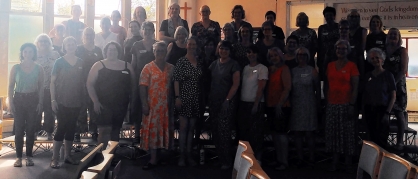
World Mixed Barbershop in Wuppertal

Wuppertal's glorious Historische Stadthalle: displaying flags from all 9 countries representedWuppertal's glorious Historische Stadthalle: displaying flags from all 9 countries represented

Last weekend saw mixed barbershop quartets and choruses from nine different countries converge to compete at the world mixed championships, hosted by Barbershop in Germany alongside their own national championships. The last time I made to BinG!’s Barbershopmusikfestival was in 2018 (we were booked also to go in 2020, but we all know how that turned out…). This was the occasion of the inaugural World Mixed chorus contest, and it is interesting to see how – and how much – things have changed in the interim.

The World Mixed quartet contest has been established for longer so the changes here are less dramatic, though it shares what was for me the headline development: mixed barbershop appears at last to have a handle on choice of key. For the first few years after the introduction of mixed ensembles at barbershop conventions I was consistently commenting on the challenges of finding a key that works for all voices in the group.

Slowing things down with SpecsAppeal

specsappealmar26

I spent Sunday with SpecsAppeal working on a combination of things that were specific to the two songs they brought with them and things that will apply to everything they sing. Unlike my difficult-to-summarise exploration of musical detail in Scotland a couple of weeks ago, we found a clear theme emerging during the day that applied in multiple different contexts: the value of taking things slowly.

The first and most literal of these recurred throughout the day: blocking passages a chord at a time, taking time to make friends with each one before you move on. In a texture where you have a four-part chord for every melody note, there’s a lot of music going on, and your brain doesn’t have time to fully absorb it all as it flies by in tempo. If you stay with a chord until you can let go of your own note and attend to the whole, your brain can make sense of it, and provide all the microadjustments to tuning, balance, tone- and vowel-match to bring it into focus.

Getting More out of Melodies

I’ve been thinking a lot about melodic shape recently in the context of a couple of pieces Rainbow Voices are working on. Specifically, I’ve been wanting to catalogue a handful of features that are often found in melodies, that, once identified, offer clues to help make the most of the tune’s expressive potential. They’re all features that you may well respond to by feel, but by bringing them to conscious awareness, you can be more purposeful in how you approach them. The point is not to replace your intuition, that is, but to understand and thus enhance it.

I’ve written about some of these principles from an arranger’s perspective in the past; this post is following through to what the implications are for singers.

  • Long notes are there to feature the beauty of your voice. When you have a long note, there is nothing to do except be glorious, so use these opportunities to take the note on a journey of beauty and meaning. The most interesting moment in a long note is just before it finishes.

Tips for Improving Choral Sight-Singing

A singer recently asked me if I had any tips to help improve sight-singing skills (‘apart from just practising’, he added, so that’s the easy answer gone). My reply was that that sounded like a blog post waiting to happen and I have spent the intervening time realising that I’d now have to do some thinking about it.

Because of course, practising is the key thing. You only get good at doing a thing by doing that thing. But the question remains as to what activities to include in your practice. Are there ways we can leverage the time to usefully hone specific aspects of the skill in ways that produce a more useful improvement than just ploughing through lots of music?

The two big challenges that sight-singing presents are, in my experience, keeping a handle on pitch, and staying with the tempo. For both, climbing back into the music when you fall out of it is central to success. Because we are all likely to make mistakes (see under ‘human beings’, and especially subcategory ‘human beings who want to get better at something’). The key differentiator between successful and unsuccessful sight-reading is less about the mistakes themselves than about the recovery from them.

Digging into the Detail with Albacappella

albacappellafeb26

I’ve just spent a happy weekend with Albacappella at their chorus retreat just outside Aberdeen. My remit was to work with them on an arrangement they had commissioned for this year’s LABBS Convention, although we also looked at their other contest piece and did some more general technique work that will apply across the board.

Some coaching trips develop a theme that runs through all our work. Looking back on this one, it feels rather more miscellaneous in focus, and thus hard to summarise. I think this is mainly because it was organised primarily around musical detail rather than skill development, so our focus shifted according to the needs of the immediate musical context. The reason for this approach is that everyone was specifically interested in what an arranger had to say about why and how they ended up with what they were singing.

Exploring the Expressive Beat with abcd

Course participants with their certificatesCourse participants with their certificates

I spent the weekend teaching the Association of British Choral DirectorsInitial Conducting course, in its new two-day format. I wrote in the past about the educational value of the previous structure of four one-day sessions a month apart. The practical downside of it was that it was hard for people to attend to the whole course, and the whole-weekend format was devised in response.

When preparing for the weekend it felt at first like trying to fit a quart into a pint pot, but as there is the expectation that people will typically do the course more than once before being ready to progress to the Intermediate course, it turned out to be actually quite manageable. And the core practical work has always been strongly tailored to individual needs, with people at somewhat different stages learning together, so in that sense it hasn’t really changed.

IABS Spring Sing

IABS Spring Sing 2026

I’ve just spent a happy weekend in Athlone as part of an international faculty at the Irish Association of Barbershop Singers’ annual spring education event, including educators from the US (Vocal Spectrum, Don Campbell) and Germany (Lucas Bitzer) as well as me from the UK. The structure of the event is built around coaching for choruses and quartets from across the association, supplemented by classes on various aspects of barbershop craft and a daily Big Sing chorus experience.

My role in the team was to do a modicum of coaching, but mostly to deliver sessions in a new initiative to develop Musical Directors and Music Teams. This included workshops for those already in post as well as sessions designed to give some initial training in musical leadership to help people not currently in such roles gain some confidence and experience to open up future possibilities for them. All organisations need to develop their pipeline of future leaders.

Back with BAC

BACfeb26

A week ago Saturday took me down to Bristol to coach Bristol A Cappella, in anticipation of their trip to Wuppertal to compete in the World Mixed Barbershop Chorus contest hosted by BinG! in March. It will be their final contest outing for the Barbie set that they took to the European and the British national contests last year. As such, we were working with material they know very well, and so the brief was all about enhancing the execution of the well-established concept rather than re-imagining anything. The main areas I was asked to focus on were resonance, swooshithroughiness, and making sure the choreography was working well with the voices.

...found this helpful?

I provide this content free of charge, because I like to be helpful. If you have found it useful, you may wish to make a donation to the causes I support to say thank you.


Archive by date

Syndicate content