Learning

Exams, Arrangements & Radio 1

NoteoriousNoteoriousMy undergraduate degree was one of those old-fashioned ones that culminated in 8 hours of written exams over two days. I recall thinking at the time, ‘Well, I think I’ve got quite good at sitting exams by now – shame really that this is the last one I’ll ever need to take’. Educationalists who like to defend the exam as an assessment strategy will point out that the capacity to complete a defined task independently within a limited timescale is a useful life skill. And I’ve always tended to think that the main legacy an exam-oriented education has left me with is the ability to focus.

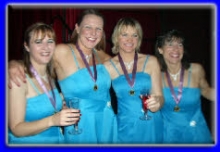
But last weekend I found myself drawing much more directly on the strategies I used to use to pass exams for a real-life challenge. Noteorious, LABBS 2008 quartet champions, had been asked by BBC Radio 1 to participate in feature celebrating four classic albums. The idea was to play tracks from these albums, alternated with cuts of the quartet singing the same songs in the barbershop style. Cute idea – and they had just one week’s notice to procure and learn the arrangements before heading into the recording studio.

Hearts in Harmony

likingOn Tuesday evening I spent a happy couple of hours with Hearts in Harmony, the staff choir at Heartlands Hospital in Birmingham. They formed back in the summer, and have been inviting various choral folk from around the region to run one-off sessions in between auditions for a permanent director. So it was an interesting session to plan, as it needed to be both self-contained (they’ll be singing with someone else next week), and provide continuity (whilst I won’t be there next week, they will). Some continuity was provided in that they had an arrangement of a Christmas carol they had started last week and wanted to work on again. So I did them an arrangement of another carol in a contrasting style that we could learn in one session, but they could then add to their collection for their Christmas performances.

New Workshops

If you came here via the front page, you may have observed a notice announcing a set of new themed workshops I’ll be offering from the New Year. More details can be found on the menu to the left, under the ‘helping performers’ label. I’ll still be available to do bespoke coaching of course, but I’ve developed the new offerings as a way to help ensembles become more strategic in how they plan their skills development.

Singing and Self-fulfilment

Pretty much anybody involved in singing is likely to be proselytising about it at times. They’ll tell you how great it makes them feel physically and emotionally, and how it makes them feel more alive and true to themselves. It can all get a little mushy and self-congratulatory, especially at events that gather a lot of singers together. ‘Singing,’ Bob Chilcott announced to delegates at the Association of British Choral Directors convention one year, ‘can change the world!’

Yeah, so what we do is special and wonderful and powerful and important, but can we just get over ourselves? I sometimes think.

Every so often, though, you come across something that makes you think: this really is special and important and actually not mushy at all. An example would be this account by a lady called Jacqueline of her experience in joining the Reading Barberettes, quoted in Voicebox towards the end of last year:

On Mental Rehearsal

Self-help books, especially those with a bit of an NLP slant, tell us that mental rehearsal is a Good Thing to do. I’ve often found their exercises in visualisation quite difficult, however – possibly because the type of thinking you’re doing while reading the instructions is quite different from the kind of full-sensory fantasy the instructions tell you to engage in. So for quite some time I thought of mental rehearsal as being some strange and special thing that I didn’t quite get.

Then one day, I was preparing a lecture, and thinking through how I was going to deliver the material – where I could probably raise a laugh, where I would need to pause to let the students catch up, where the focal points to crystallise the key ideas would come. And I suddenly realised – what I was doing was mental rehearsal, and it’s not something special at all, it’s something I do all the time. Anything that takes a spot of planning or anticipation, you can live through in prospect, whether it’s working out what you’re going to say to someone in a non-routine conversation (asking someone out, quitting a job) or planning a rehearsal.

Maybe this is obvious, but it was a revelation to me at the time.

Breathing and Musical Time

One of the things that distinguishes skilled from less skilled choral groups is the relationship between breath control and musical structure. To be sure, there are lots of other things that distinguish them, but I find this one interesting for the way that it allows a fundamentally imaginative function – conception of musical shape – to be audible through a physical response.

All singers seem to breathe according to their understanding of musical shape. However, more skilled singers have developed the capacity to choose where this might be. They think about the music and, through a combination of intuitive response and conscious decision, place the breath points in places that group the words and/or notes into meaningful gestalts. That is, they work in phrases.

Less skilled singers seem to experience music in two-bar chunks, and will breathe after each pair of bars whatever is going on in the music and lyrics.

Neurology and the Philosophy of Art

I wrote last week about Iacoboni’s book Mirroring People, and I’m sure you realised at that point that the small point I picked out to discuss was not the only thing I’d found interesting. The central theme of how we become more like each other is at the heart of the questions I set out to address in my book on choral conducting, so if I’m writing about that less here, it’s because I’ve already spent 5 years focused on that question (and indeed, talking about mirror neurons as part of how I answered it).

But there were also all sorts of twists and turns and ramifications in it that I found resonating with questions that musicians fret over.

Unconscious Competence and the Brain

competenceI recently read Marco Iacoboni’s book Mirroring People: The New Science of How We Connect with People. I would highly recommend it, despite a couple of reservations about its style.* It came out shortly after I had finished my book on choral conducting, and I think it’s fair to say that had it come out 8 months earlier there would have been more mirror neuron talk in my book. On the other hand, several of the other key theoretical sources I drew on also feature heavily in the Iacoboni, and I am very relieved to say that I find this book develops and deepens my understanding of the neurological processes that underlie the practices I discuss rather than fundamentally changing them.

One small corner of the Iacoboni that I found interesting from a general perspective of teaching and learning was his assertion that we use different parts of the brain for newly-learned and well-practised tasks. He says:

...found this helpful?

I provide this content free of charge, because I like to be helpful. If you have found it useful, you may wish to make a donation to the causes I support to say thank you.


Archive by date

Syndicate content Syndicate content