Learning

Song Maps

When I was about 12 I was flicking through the textbook we were using in our music class at school when I should have been doing something else, and found a diagram that looked a bit like this:

sonataform

I think it was in a chapter about Mendelssohn’s Hebrides Overture, though the thing that I found interesting was that it also described the shape of the Clementi sonatina I was learning at the time. I don’t recall what I was supposed to be learning in that lesson, but the revelation that you could represent an entire piece of music in a one-page picture continues to be useful to this day.

Musical Meaning and Musicality in Performance

For many years now I’ve found the distinction that Lucy Green makes between ‘inherent’ and ‘delineated’ musical meanings a useful way to think about music. It’s a dialectic between meanings that are created in and by the musical materials themselves (and she draws significantly on Leonard Meyer, another favourite theorist of mine, for this) and meanings that are attributed to music by the culture in which it subsists.

As is often the case with dialectics, the pairing has a way of constantly deconstructing itself on one hand (you find you can access the inherent meanings except through cultural filters, so do the inherent meanings really exist?) whilst still remaining a robust and useful distinction to make. I wrote about this tendency many years ago in an article that engaged with the question of whether the social meanings we find in music are carried within the music itself or simply read into it.

Through years of teaching, I’ve also observed how this distinction provides a useful way to account for how people learn music. (Indeed, I note that Lucy Green is herself a music education specialist – and one of the few who has found a dedicated readership in ‘mainstream’ musicology and music theory.)

Celebrating Peter Johnson

Prof. Peter JohnsonProf. Peter JohnsonOn Wednesday lunchtime, Birmingham Consevatoire held a concert to celebrate the work of Professor Peter Johnson on the occasion of his retirement. As a long-time friend and colleague of Peter's, I was invited to say a few words and to have the privilege of presenting his leaving gift, volumes from Catalogue d’Oiseaux. Peter's work has had a profound impact on both my own research and my relationship with my own praxis over the years, so I thought it would be appropriate to make those public thanks even more public by posting them here.


I first heard of Peter when I was a postgraduate student, and some friends who were doing PhDs in the then very new area of performance studies came home from a conference bubbling over with excitement and talking about somebody called Peter Johnson who was ‘doing the most amazing things with tuning’. As first impressions go, I think he’d be okay with that. I then met Peter myself at various conferences during the 1990s and so when a lectureship came up here in 1999, it was the knowledge of his work that gave me the confidence that my own research could find a safe home here.

Peter’s most remarkable talent is for integration.

How Do I Get More Creative as an Arranger?

Last year, over on the Facebook group for Barbershop Arrangement and Composition, Jim Emery raised the following question:

I do actually have several arrangements that are OK but not stellar. One was performed in contest by my international competitor level quartet. Several others found their way to our quartet CD. But they seem kind of vanilla. Short of just "getting more creative", I'd love to exchange ideas for how to approach sprucing them up.

(Actually, while I’m at it I’ll make this implicit plug for the FB group more explicit. It’s not maybe as active as it might be, but it has some really good people involved in it, and has a wonderful range of experience, from relative beginners to some of the biggest names out there. If you’ve not been over there, do go check it out.)

Anyway, Jim’s was one of those questions that has stayed with me. He’s really put his finger on a particular dilemma: it’s all very well to recognise that you want your arrangements to be more creative, but how do you go about making that happen?

Matching Pitch

Back in 1996, when Highcliffe Junior Choir won the title of Sainsbury’s Youth Choir of the Year, I heard their founder-director Mary Denniss make a comment in an interview that has stayed with me ever since. She was asked if she ever had children join the choir who couldn’t sing in tune. ‘Well, yes, of course,’ she replied, ‘but they pick it up after a while.’

It wasn’t just that she was so pragmatic that struck me, it was the fact that she said it so kindly. It occurred to me that much of her success in turning ordinary school children into one of the country’s best choirs lay in this calm and confident trust in her singers’ ability to learn.

Royce Ferguson in Action

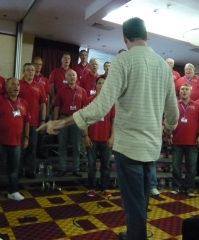
Royce Ferguson with the Cottontown ChorusRoyce Ferguson with the Cottontown ChorusAt the BABS convention last week I had the opportunity to observe Royce Ferguson coaching Bolton’s Cottontown Chorus. Royce is best known in the barbershop world as the director who took the Westminster Chorus to their first two international chorus medals in 2006 and 2007. It is not surprising therefore that he is in considerable demand as a coach and he is becoming a regular visitor to the UK in that capacity.

In his work with Cottontown he focused on the integrity of tone, on maintaining a sound that was neither breathy nor pushy. Indeed, he identified putting energy behind a breathy tone as the primary cause of vocal strain. He relentlessly insisted on a refinement of tone in which the voice is ‘always connected but never heavy-handed’. It is an active tone, not a passive one, which needs constant attention to keep it centred. He talked a lot about letting the natural beauty of the sound resonate without feeling the need to do things to it:

Art & Education

I was recently asked to write a reference for a barbershop chorus that was applying for charitable status, in response to the following question they had been asked:

Please provide independent expert evidence to show the performances are of sufficient educational merit to raise aesthetic taste.

As it happens, it’s quite a good chorus, so I could happily write in their support, and it’s quite easy to point to reasonably objective level indicators with barbershop, because the contest system is so effectively standardised internationally. The criteria are so explicit and the training regimens so thorough, that you can look at a collection of scores and articulate in some detail what they say about performance quality.

But what I found interesting was the set of assumptions built into the question.

Into the Zone

zonesI’ve mentioned before some of the useful conceptual contributions that Chris Davidson made to BABS Directors Colleges over the years, especially with introducing chorus directors to Kotter’s model of how to effect change. This diagram was another model he presented that is just one of those ‘oh yes that describes exactly how the world is’ type ideas.

So the first thing it tells us is that in order to learn anything, we have to get out of our comfort zones. That sounds kind of obvious, except that most people are very happy to spend a lot of their time studying/rehearsing/practising doing routine things in a generally comfortable way and kidding ourselves that we’re making progress. And because we’re involved in some kind of activity we’ve labeled ‘work’, we can feel nice and virtuous about what we’re doing without encountering anything that is going to threaten our egos. (This is why I spent so much of my youth practising scales.) If we want to learn, rather than simply reconfirm our current skills, we need to get out of our psychic armchairs.

...found this helpful?

I provide this content free of charge, because I like to be helpful. If you have found it useful, you may wish to make a donation to the causes I support to say thank you.


Archive by date

Syndicate content Syndicate content