Learning

LABBS Harmony College 2016: Initial Reactions

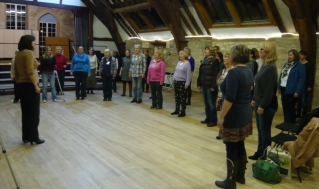
Nickie James welcomes the assembled delegatesNickie James welcomes the assembled delegatesI am just home from a rather wonderful weekend with the Ladies Association of British Barbershop Singers, in which singers from all over the country gathered in Nottingham for a weekend of education and musical bonding. LABBS hasn’t used the Harmony College format for some years, having focused instead on themed and regional events on a rolling schedule. This has had the advantage of reaching more of the membership in total, as well as allowing those with multiple roles (quartet singer and chorus director, for instance) to access education for each. But there is a buzz about a big occasion like this that anyone who was there would not have wanted to miss.

I have, as you’d imagine, a pile of notes about things I learned and ideas I want to explore, both from the Directors Stream I was running and the plenary sessions. But in the first instance, as I’m writing this the morning after I got home, the impressions I’m processing are about this sense of occasion, and how it impacts on the learning process.

On the Locus of Control

I have been thinking again recently about the concept of the ‘locus of control’, something I have mentioned every so often in this blog, but not mused about at length for some time. This is the idea that how you experience and interpret events is strongly shaped by where you attribute causation. If you believe that you make things happen, you have an internal locus of control; if you believe that things happen to you, your locus of control is external.

So I guess the first thing to note is why it is desirable to have an internal rather than external locus of control. On one hand, it affects how you feel about things: the sense that what you do makes a difference makes you feel more purposeful, less passive. You feel more optimistic about the future if you don’t feel like the victim of circumstance. On the other, it affects what you can achieve. Not everything we attempt is destined to succeed, but if we go in with the mindset that we can shape our own destinies, we are more likely to attempt things more often and to persevere longer in the face of obstacles.

Two Penny-Drop Moments

Okay, so one person’s penny-drop is another person’s blindingly obvious, but I thought I’d share two ‘Aha’ moments I had this week so you can feel smug about how you’ve known about them for years. Both were about rehearsal planning, and both arose from specific circumstances that drew things I half knew but hadn’t thought about in detail into conscious awareness.

1. The Rehearsal Focal-Point

Attention span graphAttention span graph
So, we’ve known about the attention-span graph for yonks, and I am accustomed to following its implications in rehearsal planning by scheduling new stuff during the phase just after the warm-up where people’s cognitive capacities will be at their peak. ‘New stuff’ here mostly means new repertoire, though it may mean taking on a new challenge with established repertoire in the context of a particular performance goal. But you need something new to be working on most of the time to keep people feeling like this week’s rehearsal offers something different from last week’s or next week’s.

On Kahneman’s Two Systems and the Acquisition of Skill

kahneman

Last time I wrote about this, I gave an overview of the Daniel Kahneman’s model of two types of thinking we use, their functions, and their relationship. Today I want to mull over the implications of this for teaching and learning.

The ultimate goal of skill acquisition is to get System 1 doing all your routine operations. You want to be able to do your thing fluently, automatically, with ease and pleasure. It’s not just that it feels good to work in this mode, it’s that complex tasks need so many decisions to be coordinated that even if you had the cognitive resources to make them all in real time, it would be too slow to work properly. This is how it feels performing on a bad day when your inner voice is hectoring you: you react too late, and then you over-react.

Thinking Slowly About Daniel Kahneman

kahnemanYou know you really should read a book when you find several people you know from completely different contexts all independently saying you’d like it. And when the most recent recommendation comes just before a long journey, you’re primed to make an impulse purchase when you see that book in a shop at the airport. My friends know me well: Daniel Kahneman’s Thinking, Fast and Slow turned out to be exactly the kind of book I’d enjoy reading, and then mulling over repeatedly.

My purpose today is to organise my thoughts about his central model of two modes of thinking referenced in his title: the fast, intuitive, associative System 1 and the slow, effortful and painstaking System 2. There may be future posts where I work through the implications of this model in various contexts - principally the mechanisms of unconscious bias and the process of skill acquisition - but before I start to untangle those, I need to get my thoughts straight about the underlying concepts.

Musicologie en Paris

Université Paris 8Université Paris 8

I’m going to interrupt my series on rehearsal techniques to stop and boggle for a bit about my trip last week to France for my first ever experience of a conference conducted mostly in my second language. I had been invited as one of two keynote speakers to a conference entitled Music and Gender: Current State of Research,* and although conference was genuinely international, with speakers from Brazil, Italy, Spain and Greece as well as France, England and Ireland, we were the only two to present in English.

Now, I have read a good deal of French over the years, including some reasonably dense music theory, so I wasn’t entirely unprepared for this. But most of my actual live interactions in the language have been of the ‘two beers and a cheese sandwich’ type, so in other ways this was something of a baptism of fire. I will have some thoughts to share on matters of music and gender arising from the papers and their discussion in due course, but my most immediate response is to want to reflect on what I learned about language, learning and communication from the adventure.

On the Fragmentation of Attention

I have often thought that when people complain of being short of time, it is more often that they are short of brain space. If you do an audit of every minute in your day, there are often plenty of minutes that are ‘unproductive’ if regarded from the outside. But, from the inside, you can’t make use of those minutes for anything very much because it just takes too much energy to upload something productive into your head for a brief time, and then - just when you’ve got going - dump it out again for something else.

This is of course that standard wisdom about why multitasking is inefficient - there are frictional costs of attention involved in every switch, so switch often enough and you get nothing done. Multitasking still has its place, I’d say, but only with routine tasks that you have at the tip of your brain anyway. I quite like the definition that multitasking is a technique for avoiding several dull tasks by doing them all at once.

Getting into the Detail with Cleeve Harmony

Cleeve Nov 2015As I was about to leave after my coaching session with Cleeve Harmony last Wednesday, their director, Donna, asked, ‘So what’s the blog going to be about?’ She thereby drew my attention to the process of reflection that goes into that decision. When we’ve only just stopped making music, all the multifarious things we have done together are all jumbled up in my head: vocal things, performance things, conducting things, musical things. It takes some time thinking back over it all to discover which bits are going to stand out as the bits I feel like writing about.

On this occasion, I awoke the next morning to the realisation that the part of the session that had stayed with me most vividly was an intensive 25 minutes or so focused on sorting out a sequence of just 7 chords that had never quite settled into place. You know the kind of passage - one you’ve got it near enough right that you get away with it in performance, but not right enough to feel happy with it.

...found this helpful?

I provide this content free of charge, because I like to be helpful. If you have found it useful, you may wish to make a donation to the causes I support to say thank you.


Archive by date

Syndicate content Syndicate content