Coaching

Bristol Fashion: Skills and Self-Confidence

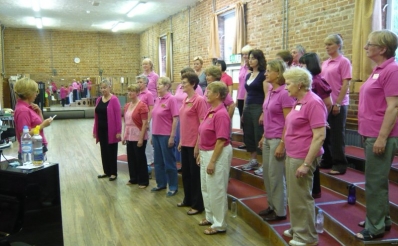
BFaug11
I spent Sunday with my friends in Bristol Fashion. I think this must have been my 5th visit in a bit over two years, and they always organise glorious weather. Even though it was drizzling when I arrived this time, once the singing started, the clouds parted. (I am sure this is nothing to either with the mild climate in the south-west of England or the fact that they always invite me in the months of May-September!)

A lot of our work this time focused less on skills per se than the psychology of confidence. There were certainly skills targeted for development (clear and positive articulation of word sounds for one), but what emerged as more central to the chorus’s quality of performance was their decision to use skills already acquired. One of the things about a group that has developed a long way in a short time is that it is very easy to default back to a lower level of performance because it is in fact not very long ago that that was the norm. They have the skills to perform with real beauty and believability to when they remember to deploy them, but they find it too easy to slip back into a more ordinary state of competence that not so long ago would have pleased them, but is no longer in the league they could be.

Chords of Crystal

crystalchordsI spent Sunday up in Manchester working with Crystal Chords chorus, who are preparing for their second LABBS Convention under the direction of Monica Funnell. Their first contest together last autumn presented an ensemble that was developing fast, but still felt a little like work-in-progress. In the intervening months they have clearly settled into their new level of skills, although they still have that capacity to pick up new ideas quickly that characterises chorus that are undergoing rapid improvement.

The result was a most productive session. As a chorus, they were very open to coaching, and took evident pleasure in their discoveries and achievements. And we really got the benefit of the work on good vocal habits they have undertaken over the last year: at no point were our musical intentions held back by limitations in vocal technique.

When’s a Good Time to Ask for Feedback?

I recently had an email conversation with someone who wanted comments on an arrangement, that framed the request for feedback as a matter of urgency, as they wanted to get the teach tracks out to their chorus. As it happens, I was in a position to juggle my schedule to fit this in, but at the same time I felt it only fair to question whether this was the right moment to be doing this.

This is a conversation I used to have frequently with students in my years as a lecturer. It was a reasonably common pattern for someone to work on an essay at length and then come for feedback only a day or two before the deadline. Often this was because they either felt there was no point in bothering me while there were still things they knew needed fixing or because they were embarrassed to show me work in an obviously incomplete (and therefore as yet inadequate) state – which does feel a bit like answering the door in your pyjamas of course. Other times it had a more cynical motivation – ‘just tell me it’s going to pass’ – which I felt rather less sympathy for, but actually didn’t change the answer.

Discoveries from a Quartet Project

Over the past few weeks, Magenta has undertaken a quartet project which has done all kinds of good things for us, individually and collectively. The initial rationale behind it was two-fold: first to generate a little more repertoire for a long gig we have coming up, and second as part of our 2011 goal to build all singers’ independence on their parts.

Back in May I asked who might be interested, and had 14 volunteers out of a choir of then 18 singers, which we all thought was a pretty good response rate. One later dropped out, but we still had 4 different quartets on the go, heading for a night in mid-July when we would all perform to each other. (The numerate will notice that this involved some doubling up.) I offered the three quartets in which I wasn’t singing a couple of 1-hour coaching sessions each en route, so long as they made sure they had rehearsed together before coming to see me.

Welwyn Well in Harmony

Welwyn
I had a fun evening on Tuesday coaching Welwyn Harmony. Earlier in the year they had commissioned an arrangement from me of ‘When I Fall in Love’, and part of our agenda on Tuesday was to work on this. I never lose the thrill of the first time I hear an arrangement sung – it’s like being in two places at once to hear something that used to just exist inside my head becoming physically audible!

And of course the possibility that I might be asked to coach a group I’ve arranged for is an important force to keep me honest as an arranger. It’s so easy, when you’re sitting at home by yourself to think, ‘Well it’s a bit awkward, but I’m sure the baritones will manage it.’ But if you know you’re going to have to face them, and indeed help them round the obstacle course you’ve constructed for them, it’s a great motivation to make the effort to make the lines singable.

Bristol Fashion Takin’ it Slow

BFjun11

On Sunday I was back with my friends in Bristol Fashion, for my fourth coaching visit since May 2009. And what a difference they have made in two years! The clarity, resonance and confidence in their singing has really improved, and each time there are more singers on the risers – it is a sure sign that things are going well when you have more people wanting to join than are leaving.

One of the encouraging aspects of coaching this chorus is that each time I go, I find the things we were working on last time well embedded and secure, allowing us to move onto new challenges. The chorus uses the technique of bubbling for continuity of breath and enhanced resonance with so much more ease and security than this time last year, and the issues over synchronisation we focused on last August are likewise much improved.

Carfield Community Charisma

carfieldjun11I spent Monday evening in Sheffield working with Carfield Community Choir on their performance skills. Last time I saw them we were working on ways to develop a sense of ensemble, and they have definitely developed a much greater sense of cohesiveness since then. They are now at the stage where they are ready to move on from a definition of success that is about not making mistakes to one that is more artistically ambitious, and it was a great pleasure to help them explore this new and exciting territory.

Masterclass with Jim Henry

Jim Henry in actionJim Henry in action

Another of the many delights at the recent BABS Convention was a masterclass run by Jim Henry on the first afternoon. Dr Jim was at the convention as bass in the 2009 International Champion quartet Crossroads, but of course he is also director of the Ambassadors of Harmony and Director of Choral Studies at the University of Missouri-St Louis. So it was only sensible to get the benefit of his choral expertise while he was there!

He spent an hour or so working with a large chorus made up of the Great Western Chorus of Bristol augmented by a large number of audience members who were invited to participate. He worked on standard elements of choral craft - breath, vowel and placement – with a brief diversion into the world of rhythmic integrity. So, the content was nothing surprising, but what was striking was the degree of improvement he effected in a very short time.

Three things in particular struck me as central to his effectiveness – and they were less to do with what he was doing than how he was doing it.

...found this helpful?

I provide this content free of charge, because I like to be helpful. If you have found it useful, you may wish to make a donation to the causes I support to say thank you.


Archive by date

Syndicate content Syndicate content