Coaching

Exploring Expressive Performance with Diversity Choir

diversity

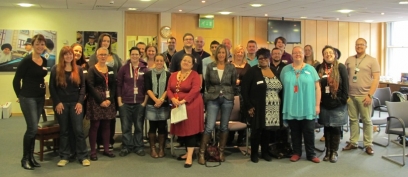
I had a trip down to Kent on Saturday to do an afternoon’s workshop with Diversity Choir on the theme of ‘Expressive Performance and the Musical Imagination’ as part of their annual retreat. We built the workshop around the music they are preparing for their concert next month, on the principle that, since the goal was to explore methods to enhance the communicative impact of the choir’s performances, the most direct way to do this was to develop them in the context of music they will performing in the near future.

We approached the workshop through the ideas of the Manager and the Communicator. These are always useful concepts, but you notice it particularly when you are working with music that is only partway through the rehearsal process. You need the Manager on duty a good deal of the time for this stage of learning, but it is also the right moment to give an explicit role to the Communicator, so that the performers’ mental map of the song has meaning, imagination and imagery built in to it, rather than just layered on top of a technical learning process.

Revisiting Avon Harmony

Through the looking-glass...Through the looking-glass...Thursday evening took me down to Bristol for a follow-up visit to Avon Harmony. I last worked with them in September, and it was gratifying to both them and me that I could hear a distinct difference made by all the work they have put in during the intervening six weeks. In particular, I noticed that not only were they much better at bubbling than before, but also all the skills that bubbling develops had improved too - continuity of breath, forward placement of tone.

The balance of coaching shifted from last time so that I was working much more through their director, Alex, rather than directly with the chorus. Since we last worked together, he has developed a much more controlled and specific gestural style, losing a lot of the distractions that his energy had been introducing. There was more of a sense of technique to be refined than the raw musical intention he had previously been running on.

Capital Connection, First Installment

capconOn Wednesday night I was down in West London to work with Capital Connection in the first of a series of three visits planned for November. It's a chorus I know quite well, but it's been a little while since I've heard them, so found myself with a pleasing combination of a previously-established trust that comes from familiarity with a freshness of listening that comes from distance.

It also creates an interestingly different dynamic when you know you are going to be following up again shortly from when any repeat visit is going to be some months away. The process of prioritising changes when you can decide to pursue something now or to leave it until next time. You can have a sense of developing an agenda that spreads beyond the one session, setting some processes in motion to return to again, while reserving other things for later, knowing they'll respond more effectively to attention once the highest priority areas are more established.

Soapbox: The Sexual Politics of Volume

soapbox
I have written before about the cultural discomfort with women singing loudly, and how some successful female singers have dealt with this. I'm going to get more pointed today, though, and specifically criticise the habit of some male coaches of systematically and radically reducing the volume at which the women they are working with sing.

First, I'm going to go out on a limb and say there is no such thing, in an absolute sense, as 'too loud' when you're talking about the unamplified human voice. When Isobel Baillie said, 'Never sing louder than lovely,' that was a statement about relative qualities, not absolutes.

Workshopping with the West Midlands Police Choir

wmpolice

I spent Saturday morning with the West Midlands Police Choir in central Birmingham, doing a half-day bespoke workshop on the theme of Developing the Ensemble. I have to say that, whilst my recent adventures have been most exciting, it was lovely to be working on my home patch for a change. It is quite a novelty to lead an event like this and still be home in time for lunch.

Within the major theme of how you turn a group of individuals, each with their own heart, brain and voice into a single performing unit, we had two main areas of focus: finding common approaches to using the voice, and opening up the ears and sense of mutual awareness between the singers.

Another Windsor Wednesday

windosr2

Wednesday took me back to Windsor for a second visit to the Royal Harmonics. In some ways it feel like no time at all since I was last with them, but I couldn't help but notice that it was light when I arrived for my previous visit, but this time night had already fallen.

It was a pleasingly productive evening's work, with focused attention on several different pieces covering a wide range of musical and vocal issues. Their director, John Palmer, had some very clear agenda items for the songs he had picked to work on, but at the same time balanced his areas of interest with an openness for my diagnoses of a song's highest priorities for work. Sometimes the areas I picked up as the most important for attention were the same as the ones he had ear-marked to work on, whilst sometimes I brought up things that had not particularly been on his radar; either case was useful and interesting.

Ireland Unlimited

IrelandUnlimited
My Irish tour continued with a weekend’s work with Ireland Unlimited, the country’s premier barbershop chorus. Drawn from across the country, they meet for one day a month, and the skills developed centrally have also been significant in supporting and developing the skills in local choruses. I suspect Ireland Unlimited of having a significant hand in the improvement in performances I noticed when judging the IABS Convention this time last year.

The invitation to Ireland Unlimited’s retreat was the kernel around which my mini-tour had grown. I was working alongside Jon Conway, who has been working with IU on singing for some time, and as ever it was both stimulating and relaxing to cox-and-box with another coach. Having different faces in front of them keeps the chorus fresher, and we each get more chances to catch our breath and collect our thoughts, so our coaching is that much more focused and to the point. And of course it is always a joy and delight to see experienced colleagues in action and learn from them.

Nota Bene

notabeneMy coaching trip to Ireland continued with a day’s work near Dublin with Nota Bene quartet. They have formed under this name relatively recently, though three of them competed last year in Galway under a different name, and two have sung together in quartet for nearly five years now. This kind of profile offers both specific challenges such as adjusting existing vocal relationships to take account of the new singers’ voices and ways of feeling music, and specific advantages, with the know-how of the more experienced quartet singers supporting the newer additions.

...found this helpful?

I provide this content free of charge, because I like to be helpful. If you have found it useful, you may wish to make a donation to the causes I support to say thank you.


Archive by date

Syndicate content Syndicate content