

Arranging

On Range and Tessitura

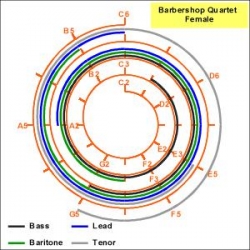
A rather nice way of showing vocal ranges visually, from PhonatureA rather nice way of showing vocal ranges visually, from PhonatureThis week saw the addition to my arrangements catalogue of information about the ranges for each part. It took quite a long time to work through all parts of every arrangement, but I’m hoping it will save you time in emailing me to ask, and me time in answering. And the process gave me lots of opportunity to reflect on the meaning and usefulness of this information.

At the most basic level, range is the primary criterion for deciding on an arrangement’s suitability for a particular ensemble. If the person singing that part doesn’t have notes used at either top or bottom, there’s no point attempting the song, as it will always over-stretch the group – and at key musical points, too. (Extremes of high and low notes never appear casually or en passant.)

But range doesn’t tell you everything you need to know about how a song lies on the voices.

Unity and Variety

The balance between unity and variety in music is a technical/artistic challenge that composers have been grappling with for probably as long as they have been writing music. It seems to become a more urgent issue, however, when you head into the nineteenth century with the development of the idea that works should be individual – that they should have recognisable identities that distinguish them from all other works. There are all sorts of reasons for this aesthetic shift, but changes in listening habits are indicative. When the orchestra is the background music for a duchess’s card game, symphonies can be more generic, but when the lights are lowered to put everyone’s attention on the orchestra, the music needs to do more to distinguish itself.

Those of us writing a cappella arrangements of popular songs from the last century might be working on a more modest scale than the nineteenth-century symphonists, but we face similar artistic and technical challenges. Specifically, there is the question about how much to repeat stuff. It’s a simple question, but the answer is always interestingly non-obvious, because of the effect that repetition has on a piece’s sense of identity.

Exam Results

Noteorious at their Maida Vale recording sessionNoteorious at their Maida Vale recording sessionWell, Noteorious have enjoyed a good bit of airplay this week on Radio 1 – appearing not only at ungodly o’clock on Dev’s show, but popping up elsewhere through the days to promote the Masterpiece shows each evening. So, I think that means I passed the arranging test. And for those who have been sensibly asleep first thing in the morning, there are now some nice videos of them singing the arrangements on Dev’s website:


Daft Punk
The Clash
The Streets
Metallica
And an interview with clips of all four

Exams, Arrangements & Radio 1

NoteoriousNoteoriousMy undergraduate degree was one of those old-fashioned ones that culminated in 8 hours of written exams over two days. I recall thinking at the time, ‘Well, I think I’ve got quite good at sitting exams by now – shame really that this is the last one I’ll ever need to take’. Educationalists who like to defend the exam as an assessment strategy will point out that the capacity to complete a defined task independently within a limited timescale is a useful life skill. And I’ve always tended to think that the main legacy an exam-oriented education has left me with is the ability to focus.

But last weekend I found myself drawing much more directly on the strategies I used to use to pass exams for a real-life challenge. Noteorious, LABBS 2008 quartet champions, had been asked by BBC Radio 1 to participate in feature celebrating four classic albums. The idea was to play tracks from these albums, alternated with cuts of the quartet singing the same songs in the barbershop style. Cute idea – and they had just one week’s notice to procure and learn the arrangements before heading into the recording studio.

Managing Expectations in Vocal Arrangements

Regular readers will have noticed that I like to draw on the ideas of Leonard B. Meyer when I think about music. I was first introduced to his work in my first year at university, and it had quite a big impact on me, as it was my first real encounter with the act of theorising music. Hitherto most of the writing about music I had seen simply described what was going on, whereas this introduced me to the possibilities of explaining it.

(This early encounter also provided the occasion for possibly the most useful thing anyone ever said to me during my education. My tutor, Alan Rump, had sent me away to read some Meyer, and I came back saying tentatively that I found it very interesting but wasn’t sure that I agreed with it. ‘Good God, woman,’ he roared, ‘You’re not supposed to agree with books, you’re supposed to think about them.’)

Anyway, some recent listening experiences got me thinking about his implication-realisation model of musical meaning again.

Arranging for choral or one-a-part groups

I mentioned in my post a few months ago on arranging for 8 parts that I’d need to come back to the question of what makes an arrangement suitable for a choral ensemble versus a quartet/octet – and indeed, what makes an arrangement suitable for either.

Arranging to Commissions vs Arranging for the ‘Mass Market’

In a comment on my post last week about getting known* as an arranger, Mark queried why I seemed more interested in arranging for commissions rather than for ‘the mass market’. I made a brief reply there, but his question stayed with me, and made me articulate some things to myself about the process of arranging that I thought might be interesting to share.

Getting Famous as an Arranger

Happy Together sheet musicMy new friend Mark wrote the following in an email to me a couple of week's back:

Maybe you could blog a bit about how you got your first arrangement accepted for publication by the [Barbershop Harmony] Society. I'd be very interested to hear your story.

So, this post is for him.

...found this helpful?

I provide this content free of charge, because I like to be helpful. If you have found it useful, you may wish to make a donation to the causes I support to say thank you.


Archive by date

Syndicate content Syndicate content