
Add a comment
World Mixed Barbershop in Wuppertal
‹-- PreviousNext --›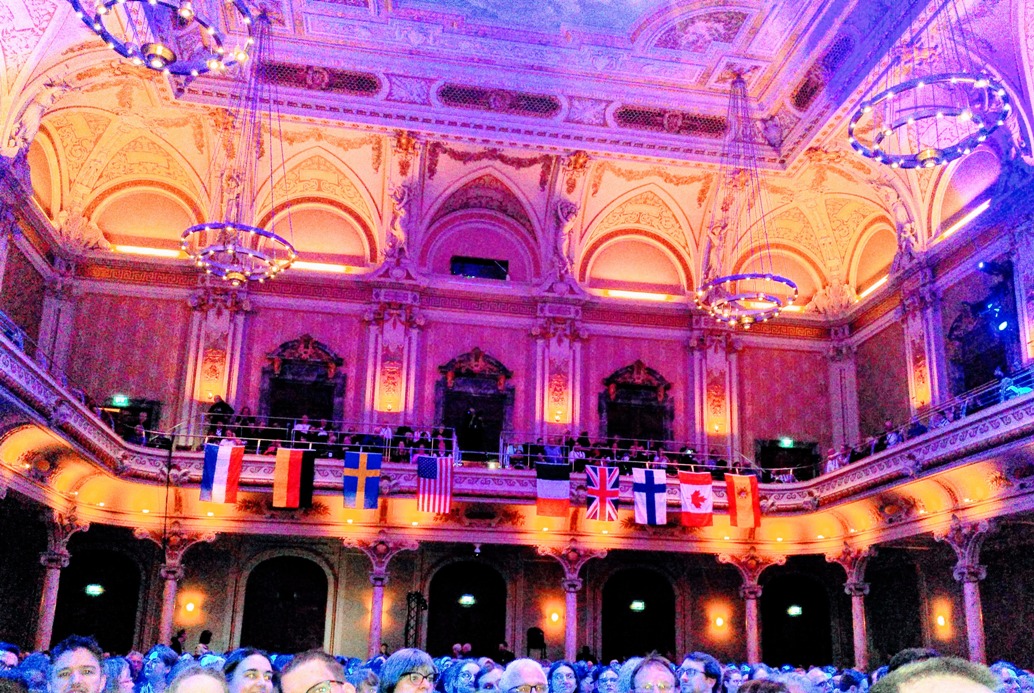 Wuppertal's glorious Historische Stadthalle: displaying flags from all 9 countries represented
Last weekend saw mixed barbershop quartets and choruses from nine different countries converge to compete at the world mixed championships, hosted by Barbershop in Germany alongside their own national championships. The last time I made to BinG!’s Barbershopmusikfestival was in 2018 (we were booked also to go in 2020, but we all know how that turned out…). This was the occasion of the inaugural World Mixed chorus contest, and it is interesting to see how – and how much – things have changed in the interim.
The World Mixed quartet contest has been established for longer so the changes here are less dramatic, though it shares what was for me the headline development: mixed barbershop appears at last to have a handle on choice of key. For the first few years after the introduction of mixed ensembles at barbershop conventions I was consistently commenting on the challenges of finding a key that works for all voices in the group.
In the early years, groups most typically chose a key nearer the TTBB pitch, leaving most female singers growling around in tessituras that were too low for them. Over time, this became somewhat less of an issue, and I started remarking more on issues of balance, how the compromises people needed to make to find a key accessible to all singers often left the core range where leads and baritones interweave underpopulated, with a concomitant impact on the classic pyramid balance of barbershop sound.
In Wuppertal at the weekend I heard maybe just two or three passages where a female lead was pushed into a register that didn’t fully meet the expressive needs of the music, and these just served to highlight how those previously endemic problems appear to have been largely solved. I am sure this reflects in part the learning process of groups that may have started out for single projects but that have now become well-established teams. It also reflects changes in the musical structures themselves as arrangers adapt to the needs of groups whose vocal profiles are significantly different from those of the traditional single-sex groups in which the style evolved.
(Tangential thought: one wonders whether male arrangers, having learned to adapt for SATB textures, will start to think a bit more clearly about the distinctions between TTBB and SSAA ensembles.)
Another feature of musical structures to emerge from the weekend is the role of the monster medley as statement of ambition. Pastor Hannes Kör have been doing this for years in the quartet scene of course, establishing themselves as a must-see group who use comedy as a vehicle to make their audience feel special. But the top-three placed choruses also brought extended themed medleys to the stage. Beyond the musical impact of such long arcs of musical time was again a sense of occasion: you really felt they had made the effort for us.
Intermingled with the extravaganzas of the World Mixed contests we also got to hear the state of the nation for the German home scene. And you would have to say it is sounding in good shape. The voices are sounding healthy, which not promotes musical integrity, but suggests that the singers are also collectively in a good place emotionally. When you’re generally feeling well settled in your world the voice flows more freely.
Another indicator of the health both of BinG!’s home scene and its relationship with international barbershop was that I think this is the first time I have ever heard of a convention being completely sold out weeks in advance. To be sure, the Historische Stadthalle in Wuppertal is not the largest venue, but it had clearly been chosen as having a realistic capacity for the size of event anticipated from past experience.
I’m not sure how many of the extra numbers came from more ensembles participating than expected (the contest schedule was very full!), how many from the choruses being bigger than expected (there were some huge ensembles, and even the small groups were bigger than in previous years), and how many from non-competing audience members who wanted to be there to witness a high-quality international event – and of course the more performers participate, the more friends and family will come along to support them. I’m guessing that next time they’ll book a bigger venue, but still we’re all on notice to register in good time to avoid missing out.


You may also like ...
|
Node 2,820
Weight = 3. Links to On Voicings for Mixed Barbershop Choruses (2), One tag in common [481 posts have this] A Cappella (1) 
|
Node 2,722
Weight = 3. Links to BABS QuartetCon 2021 – Further Random Thoughts (2), One tag in common [481 posts have this] A Cappella (1) 
|
Node 2,293
Weight = 3. Links to BinG! Barbershop Musikfestival 2018 (2), One tag in common [481 posts have this] A Cappella (1) 
|
Node 1,574
Weight = 3. Links to Thoughts on the Mixed Quartet (2), One tag in common [481 posts have this] A Cappella (1) 
|
